The word the press latched onto, to describe the ongoing jigsaw of Bowie’s career, was “chameleon.” It’s not a very good word: Chameleons change continually so they won’t be noticed, which was not an option David Bowie ever entertained. He regenerated periodically, trying on new faces, reacting against his former selves. If his work was any guide, success made him move harder and faster in new directions, jumping into “plastic soul” at the peak of his glam fame, rejecting art-pop godhood in the ’80s to turn suited and slick, and then jumping again into the cacophony of Tin Machine.
In fact, he wouldn’t be the first to observe the strange phenomenon of Trump/Sanders support crossover.
It seems counterintuitive – there seems at first glance to be little common political ground between the two – but at previous Trump rallies, supporters have been quoted by journalists as picking Vermont senator Bernie as their second-choice.
Hot Air chalks it up to the “blue collar coalition” both candidates are developing; moreover, Sanders has in the past publicly appealed to Trump supporters to back him instead, and even instructed his canvassers with specific scripts to lure Trump supporters.
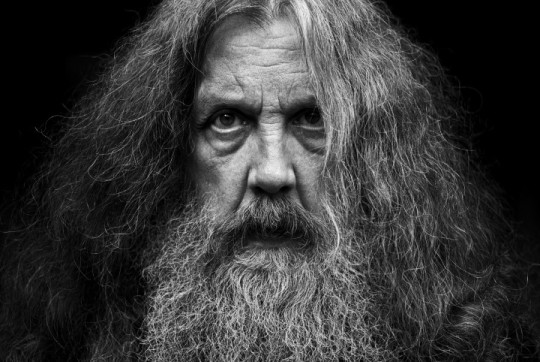
Alan Moore’s new prose novel Jerusalem has long been in the works, and now we know when it will be released: September, 2016. Less than a year from now, we will once again enter the mind of Alan Moore through language alone, as we did through his masterful first novel The Voice of the Fire (available from Top Shelf Productions).
Gosh London has published Moore’s promotional blurb for Jerusalem, and it sounds like readers are in for more of a mind-blowing experience than even Voice of the Fire provided:
In the
half a square mile of decay and demolition that was England’s Saxon
capital, eternity is loitering between the firetrap tower blocks.
Embedded in the grubby amber of the district’s narrative among its
saints, kings, prostitutes and derelicts a different kind of human time
is happening, a soiled simultaneity that does not differentiate between
the petrol-coloured puddles and the fractured dreams of those who
navigate them. Fiends last mentioned in the Book of Tobit wait in
urine-scented stairwells, the delinquent spectres of unlucky children
undermine a century with tunnels, and in upstairs parlours labourers
with golden blood reduce fate to a snooker tournament.
Disappeared
lanes yield their own voices, built from lost words and forgotten
dialect, to speak their broken legends and recount their startling
genealogies, family histories of shame and madness and the marvellous.
There is a conversation in the thunderstruck dome of St. Paul’s
cathedral, childbirth on the cobblestones of Lambeth Walk, an estranged
couple sitting all night on the cold steps of a Gothic church-front, and
an infant choking on a cough drop for eleven chapters. An art
exhibition is in preparation, and above the world a naked old man and a
beautiful dead baby race along the Attics of the Breath towards the heat
death of the universe.
An opulent mythology for those without a pot to piss in, through the labyrinthine streets and pages of Jerusalem
tread ghosts that sing of wealth and poverty; of Africa, and hymns, and
our threadbare millennium. They discuss English as a visionary language
from John Bunyan to James Joyce, hold forth on the illusion of
mortality post-Einstein, and insist upon the meanest slum as Blake’s
eternal holy city. Fierce in its imagining and stupefying in its scope,
this is the tale of everything, told from a vanished gutter.
Posted on
Posted on
The mother of two, from Cardiff, has suffered from retinitis pigmentosa – an inherited disorder – since she was five. The condition causes gradual deterioration of photoreceptors, the light-detecting cells in the retina, which can lead to blindness. One in 3-4,000 people in the UK have the disease, for which there is currently no cure.
Lewis is completely blind in her right eye and has virtually no vision in her left eye. The implant, made by a German firm, Retina Implant AG, was placed in Lewis’s eye in June in an operation that can last six to eight hours.
During follow-up tests, Lewis was asked to look at a large cardboard clock to see whether she could tell the time. She had not been able to tell the time with her right eye in 16 years or with her left eye for about six years.
She said “Oh my god” when she realised she had managed to recognise it was three o’clock. She added: “Honest to god, that felt like Christmas Day.”