Killer Mike, a rapper I grew up listening to and who Marvel recently paid homage to with the Run the Jewels variant covers, once said, “Closest I’ve ever come to seeing or feeling God is listening to rap music. Rap music is my religion.”
I can relate. A few years ago, I found myself in Tokyo for work. I don’t speak Japanese, but that didn’t stop me and my friends from running wild over the city for a few days. One of my favorite experiences—a cherished experience—was when I ended up in Shibuya looking at shops. I found a streetwear spot that was down some stairs and around the corner. It didn’t look like a streetwear shop from the outside, but the signage and windows had a vibe, so I stepped in.
Inside were a couple customers and two shop workers. I was the only black guy in the room, and it was small, so I shopped quickly and went to check out. The clerks didn’t speak English, but they definitely spoke hip-hop. They saw my shirt, a riff on Nas’s “Illmatic” cover, and we bonded over one of the greatest rap albums of all time, kicking favorite lines back and forth. I paid and left, richer for the experience. We connected because we’re part of the same culture.
I say this not to brag, but to emphasize this: I’m squarely in the target audience for the rap covers you’re homaging, and I know first-hand how incredible rap music actually is.
Rap is worldwide, but rap is black, too. There’s white in there, and where would rap music be without our latin brothers and sisters, but in terms of perception, coding, impact, and legacy: it’s a black art form. Undeniable, like saying “Midnight Marauders is the best A Tribe Called Quest album.” (That’s a rap joke, too.)
One issue with Marvel publishing hip-hop-themed covers in the wake of not hiring black creators is that…a dialogue goes two ways. Axel Alonso said Marvel has been in a long dialogue with rap music, but that isn’t true. It’s a long monologue, from rap to Marvel, with Marvel never really giving back like it should or could. Break the Chain was decades ago, you know? (I did appreciate the Aesop Rock shout-outs in Zeb Wells & Skottie Young’s fantastic New Warriors from way back, however!)
One has to do with the other because of optics. If you don’t employ black creators, and then you purport to celebrate a black art form for profit (and props on hiring a few ferociously talented black artists for the gig!), people are going to ask why that aspect of black culture is worth celebrating but black creatives aren’t worth hiring. I know how many black writers Marvel has hired and allowed to script more than two consecutive issues of a Marvel comic. Do you? Do you know how many black women have gotten to write for Marvel?
Or, more directly: Storm is the highest profile black character in comics. Which is great! But…she’s mostly been written by white men, and a very small fraternity of black men, throughout the decades. Imagine what a black woman could bring to the character. Shouldn’t a black lady get a chance at bat? I grew up on Alison Sealy-Smith, and I’ve got a soft spot for Halle, but there’s a gap there.
Back to optics: you can’t celebrate and profit off something without also including the group that you’re profiting off the back of. Marvel has made a lot of money off brown faces. A portion of X-Men’s juice is from the struggle for civil rights, and we all know what the phrase “black Spider-Man” has done for the perception of your company. (He’s Puerto Rican too, tho.) So to see Marvel continue to profit off something very dear to black people without actually giving black people a seat at the table…I was going to say it “stings,” but in actuality it sucks. It makes Marvel look clueless and it makes black people wonder why they bother with your comics.
Whit Taylor’s “The Fabric of Appropriation” went up this week. It’s a measured look at cultural appropriation, both why it happens and how. Her last point (which I’m going to spoil, forgive me) is that “maybe it’s not so much about who has control over a design, but whether the people it originates from feel in control of their identities.”
With these hip-hop covers? You’re in our house. (“Whose house?”) These albums changed lives, provided the soundtrack to our youth, or maybe just sounded really nice with the bass cranked and the treble at half on the EQ. To claim you’re paying homage (for profit, with no-doubt rare variant covers to be sold at a mark-up to an audience that often does not include the people these albums were created by) while simultaneously not being willing to hire the people who could bring those concepts to your comics in an authentic fashion…the optics are bad, man.
Jay-Z once said, “I came back and it’s plain, y’all niggas ain’t rappin the same. Fuck the flow, y’all jackin our slang. I seen the same shit happen to Kane.” He was talking about biters, aka shark biters, aka culture vultures, aka cultural appropriators.
If you’re going to homage hip-hop, do it in the best way possible: keep it real and put some people of color behind the pages in addition to on them.
“Protons Electrons Always Cause Explosions.” Thus spake the RZA, whose favorite Marvel superhero is the Silver Surfer.
But there is one problem that a sharp eyed reader pointed out.
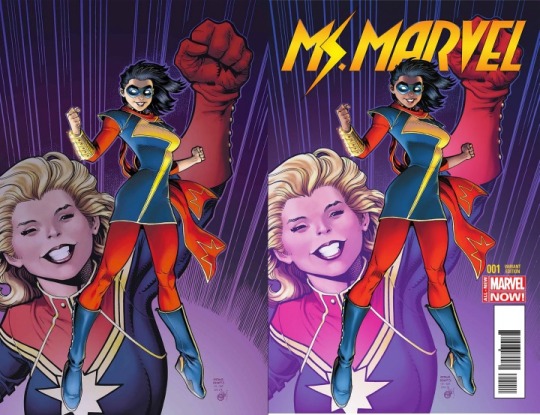
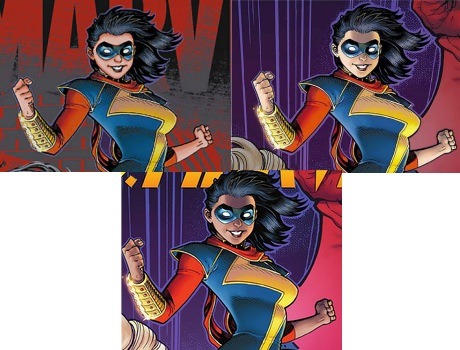
The image of Kamal Khan is taken from the Art Adams variant for the first issue.
That cover was “tweaked” before publication because Kamala was a little, well, white. See below the original and the final version.
The t-shirt uses the first one. Below see the shirt and the original cover with the final cover belwo.
Given that it seems Disney is making these to order (hence the limited edition and 3-5 weeks for delivery they should be able to correct this before they go into production. It’s an easily understood mistake but one that should definitely be corrected.
Assuming that the Bleeding Cool rumors are true, here’s a checklist of the All-New All-Different Marvel titles announced/rumored so far:
Officially announced: All-New, All-Different Avengers by Mark Waid, Adam Kubert and Mahmud Asrar Invincible Iron Man by Brian Michael Bendis and David Marquez Spider-Man by Brian Michael Bendis and Sara Pichelli Doctor Strange by Jason Aaron and Chris Bachalo Captain Marvel by Tara Butters, Michelle Fazekas and Kris Anka Squadron Supreme by James Robinson and Leonard Kirk A-Force by G. Willow Wilson and Jorge Molina Totally Awesome Hulk by Greg Pak and Frank Cho Uncanny Inhumans by Charles Soule and Steve McNiven Ant-Man by Nick Spencer and Ramon Rosanas Spider-Gwen by Jason Latour, Robbi Rodriguez and Rico Renzi Contest of Champions by Al Ewing and Paco Diaz
Bleeding Cool rumors: Web-Warriors by Mike Costa and David Baldeon Daredevil by Charles Soule and Ron Garney Deadpool by Gerry Duggan and Mike Hawthorne Venom: Spaceknght by Robbie Thompson and Ariel Olivetti Howling Commandoes of SHIELD by Frank Barbieri and Brent Schoonver Angela: Asgard’s Assassin by Marguerite Bennett, Aaron Kim Jacinto and Stephanie Hans Uncanny X-Men by Cullen Bunn and Greg Land Extraordinary X-Men by Jeff Lemire and Humberto Ramos All-New X-Men by Dennis Hopeless and Mark Bagley Wolverine by Tom Taylor and David Lopez Old-Man Logan by Jeff Lemire and Andrea Sorrentino Karnak by Warren Ellis and Geraldo Zaffino The Vision by Tom King and Gabriel Hernandez Walta Illuminati by Josh Williamson and Shawn Crystal Spider-Woman by Dennis Hopeless and Javier Rodriguez The Ultimates by Al Ewing and Kenneth Rocafort Carnage by Gerry Conway and Mike Perkins Scarlet Witch by James Robinson and TBD Silk by Robbie Thompson and Stacey Lee Uncanny Avengers by Gerry Duggan and Ryan Stegman Agents of SHIELD by Marc Guggenheim and Mike Norton New Avengers by Al Ewing and Geraldo Sandoval Sam Wilson, Captain America by Nick Spencer and Daniel Acuna Hawkeye by Jeff Lemire and Ramon Perez Star-Lord by Sam Humphries and TBD Guardians of the Galaxy by Brian Michael Bendis and Valerio Schiti Amazing Spider-Man by Dan Slott and Guisseppe Camuncoli Howard the Duck by Chip Zdarsky and Joe Quinones Spider-Man 2099 by Peter David and Will Sliney Drax by CM Punk and Ed McGuinness Nova by Sean Ryan and Cory Smith Ms. Marvel by G. Willow Wilson, Takeshi Miyazawa and Adrian Alphona The Mighty Thor by Jason Aaron and Russell Dauterman
Posted on
Delevingne’s comments about female superhero attire is a little head-scratching, though. While there are plenty of problems with female representation both in films and especially on movie merchandising, the accusation that they are “normally naked or in bikinis” seems a bit baseless. Even though Marvel sticks to a heavily skewed gender ratio and tends to put women heroes in impractical high heels and wedge boots as a default, their characters never wear bikinis; Black Widow, Peggy Carter, Maria Hill, Sif, Gamora and pretty much every other heroine in that universe always go into battle wearing pants.
We’ve yet to see what Enchantress will be wearing in “Suicide Squad.” We have seen plenty of pics of the film’s version of Harley Quinn, who shows a bit more skin than many – or all – of her Marvel counterparts.
Yes, instead of concentrating on Cara Delevingne’s commentary about superhero movies being sexist in general, let’s turn this into a Marvel vs. DC thing. Never mind the fact that she specifically called out Wonder Woman in her actual comments, making it clear that she wasn’t taking sides herself. Never change*, comicsinternet. (*Of course, I mean the opposite.)
Posted on
Posted on
Posted on
The Radical Faeries, one of the more idiosyncratic groups at San Francisco’s Pride, said the festival should dump Facebook as a sponsor because of the company’s ban on adopted names.
The policy was unfair to LGBT people who use adopted names to avoid homophobia or to express their true identity, they said.
“I don’t like anybody telling me who I am or have to be,” said Storm Arcana, 42, seated on a rug in the Faerie Freedom Village, a colourful camp near city hall.
“That’s anathema to my essence. I’m self-defined and self-described and that is my right.” He objected to Facebook sponsoring Pride. “There’s too much of a contrast between what they represent and what we represent.”
The strangest thing about this report is that I know Storm, and seeing him show up in the Guardian was entirely unexpected. (I do think the no-adopted-name thing on Facebook is problematic, though.)