All Over The World, Tonight, All Over The World

I’ll admit it straight off; there were times today where being in Venice seemed like a bizarre abstract notion, like it wasn’t really real, and all the stress and the phone calls (and all the “Can you speak English?”s) and all of that were just trials I had to go through to test my patience or something, and there wasn’t really an outcome to it. Even wandering through London this afternoon, killing time between flights, it didn’t feel like anything that unusual. And the plane here I just felt lost and thed different with a sense of history about it (compared to Aberdeen… I mean, come on), drifting through places with exotic names. Without realizing it, I’d disappeared from real life and started living in a film after all. Gondoliers went past, singing, and it’s not often you can say that. Add to that the fact that sheer luck led me to ask a complete stranger (who turned out to be French) the way to my hotel, and she took me to the very door, and you know I’ve been pretty blessed.

I’ve found something called Kind of Hush, which was a travel diary I wrote back in 1999 from a trip I took to Venice. Re-reading it, I realized that it was my first paid journalism; I wrote it to fulfill a grant I’d been given by the Scottish Arts Council to visit that year’s Venice Biennale. Because I’ve been thinking, endlessly, about Kindle Singles and digital ebooks a lot lately, I’m re-working this (Trying to find the missing text from the file I found this weekend) with an eye of putting it out there for 99 cents just because. I doubt anyone would buy it, but I just like the idea of it being out there.
A Change Is As Good As A Rest, Except A Rest Is Easier

And here I am at Time again, writing about the Robert Kirkman/Tony Moore legal tussle over authorship of The Walking Dead ahead of the television show’s return this weekend. I don’t normally write straight “This happened, and then this happened” pieces for Time – normally it’s more op-ed and conjecture – so this was a nice change, in terms of ease of writing (The structure was already in place!). We’ll see if people dig it, I guess.

“I Think That’s An Old Frame of Thinking, And We’re Trying To Break Out of It”

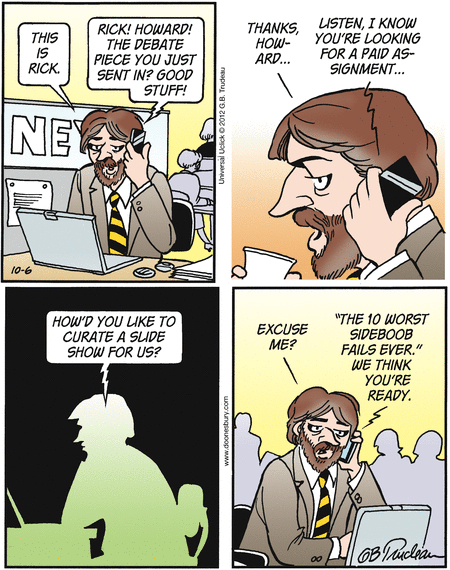
But to BuzzFeed Executive Editor Doree Shafrir, who is leading the hiring search, the idea that there are “fun” posts and “other” posts is an antiquated way of thinking. Instead, BuzzFeed requires three things of each story: that it entertain, inform, and manifest itself as something people want to share with their friends.

“Almost everyone always wants to talk about this split, which I feel is sort of a false dichotomy,” Shafrir says. “Why should we take for granted that a sort of quote, unquote ‘longform,’ serious piece won’t be shared on social media, as if the two things can’t exist in one ecosystem? I think that’s an old frame of thinking, and we’re trying to break out of it.”

From here.

I don’t know if the Internet is willing to accept the idea that longform journalism is going to make a comeback, but I like the idea that more and more people are willing to at least consider it (Things like this, Byliner, and Kindle Singles make me hope that there’s going to be some way of not only making longform journalism a going concern, but also a profitable one. Just imagine, as the saying goes).

“Originality Is Elusive Today”

Originality is elusive today in every place that people write – not just in journalism, but in academia, professional writing, book publishing, speech writing and politics.

In our panic to keep up with a changing world, we’ve failed to identify new methods for originality. We need to look to the writer-editor relationship, to the community of writers and thinkers, and to the very process that writers use to go from nothing to something.

From here.

It has to be said; my relationship with my editor at Time’s Entertainment vertical – who pushes me beyond the first pitches for a story, and then offers and suggests edits to the first draft that always make it a far stronger story – is something that I really treasure. It makes me a better writer, definitely, but so does having the time to take three days or so to get the Time story done. I agree that there needs to be more push towards original thinking in modern writing, but the sheer pace of most online writing works against that, in my experience.

Best Response Ever?

If Andy Williams hadn’t died, my Time piece would’ve been the most popular article on the Entertainment vertical today. Another reason to be sad about Mr. Williams’ passing, dammit! As it is, it did generate this spectacular response: “I really enjoyed your ST:TNG piece. It could have been shorter.” Thanks, I guess?

Here it is, for those of you know need convincing that Star Trek: The Next Generation actually predicted the future.

This Is Why I Don’t Write Books (Not Really)

The fact that Penguin is suing authors for neither writing a book nor returning the advance they were given to do said writing is a weirdly entertaining concept to me, for some reason (Despite the fact that one of the authors being sued is Ana Marie Cox, whom I happen to enjoy as a writer more than a little bit). What makes it especially interesting to me is that all of the authors being sued are non-fiction writers; is it just that non-fiction writers flake so badly on contractual agreements, or is there something else happening here?

Part of me really likes the idea of one day writing a book, but then I see this and I just imagine myself being one of those non-fiction writers who’d end up having to hand back payments after missing the deadline or two.

Obsessions, Not Beats

So instead of fixed beats, we structure our newsroom around an ever-evolving collection of phenomena—the patterns, trends and seismic shifts that are shaping the world our readers live in. “Financial markets” is a beat, but “the financial crisis” is a phenomenon. “The environment” is a beat, but “climate change” is a phenomenon. “Energy” is a beat, but “the global surge of energy abundance” is a phenomenon. “China” is a beat, but “Chinese investment in Africa” is a phenomenon. We call these phenomena our “obsessions”.

That’s Gideon Lichfield, editor of an about-t0-launch business news site Quartz, writing about what’ll make the site different. I like it a lot as a model – The idea that writers don’t have particular “beats” or areas they have to follow, but will instead follow particular stories wherever. It strikes me as a smart reaction to the decentralization of media thanks to the Internet (Now people want to follow stories and ideas, not particular areas, as readers, I think, a lesson they’ve learned from reading bloggers go wherever they want), and I’m curious to see how it works out.