One thing that struck as extra-odd was the idea that there’s hell to pay in terms of people holding grudges. I haven’t found this to be true over the life of what I shudder to call a career in comics. People get grumpy and pissy about stuff, but actually holding a lingering resentment? It doesn’t seem to happen because of critical discourse. The publishers of this site once conspired to label Adrian Tomine a moron and a piker; here’s him holding a grudge. I think I’ve interviewed all of the comics pros that went after me hard during that same era. Two of the comics professionals I like most currently are people with whom I’ve had massive differences of opinion in the critical realm. Many of the other people of whom I’m most fond in comics are very critical of my own work. I worked for King Features seven months after writing really negative articles about King Features.

Reading this, I had two immediate responses. The first was a cynical, “Clearly, Tom hasn’t criticized enough Big Two comic books/comic book creators*” and the second, a more wistful “Why can’t I be like Tom?”

I agree that there’s not “hell to pay” about people holding grudges, although I’ve certainly had experiences where people holding grudges against me have had problematic impacts on my life and my job in ways I wouldn’t have anticipated. But for the most part, what can you do about people holding grudges, especially if you’ve apologized and tried to rebuild bridges you didn’t even know existed before apparently burning them down? Some people are just resentful and petty and angry, and you have to just let them be like that, I guess.

(* That sounds like sarcasm, but it’s not; I genuinely think creators and staff working for those companies trend towards paranoia and grudges more easily than independent cartoonists for reasons that essentially come down to the corporate culture in which they have to operate and the Internet culture which has built itself up around those companies, but that might be my own personal experience forming an entirely unrealistic bias.)
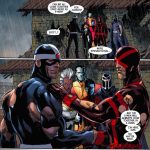
So much of this series is tied up in hoping that I, as a reader, cares about the Watcher being killed, about whatever new retcons the writers have thought up, and about Nick Fury as the man on the wall. As stories, all of those can be great, but as concepts, they’re just ideas on the page that excite me as much as any random creator interview, which is not a lot. Watching as the characters run around over the paper-thin surface of this ‘story,’ they become increasingly less motivated by anything internal and just seem like cogs.

For starters, there’s no real explanation of what an Onslaught is. Is the Red Skull actually dead or transformed? Is Red Onslaught a separate entity and the dead Red Skull’s voice is still somehow around? Is the Red Skull in control of Onslaught? I have no idea. I guess if I’d read the Onslaught X-Men comics back in the mid-90s, I might know, but I dropped those like a brick before the lead-in to outsourcing the core books to Image happened. That wasn’t really covered here except a line about Onslaught being a construct of pure hate, which didn’t exactly enlighten me. Still, the character (characters?) has multiple voices which seem to be dominant at different times and it wasn’t exactly clear storytelling. The story reads like everyone is supposed to know what an Onslaught is. If the characters were confused, I might not feel like I’m missing out on something.

This made me feel very glad I decided not to try out Axis today after all. I’m burned out on Marvel events and the whole massive continuity clusterfuck of them all.

I’m finding a balance. I usually have a bad time at comics parties/events, so I focus on what I know works for me instead of the event-oriented nightlife. Finding a dark corner somewhere, leaving the con, walking and talking, whatever whatever. Talking about comics with strangers. I’ve taken to doing quiet, small-scale dinners with close friends instead of the sprawling comics dinners. Starting the show off on a good foot with a no-pressure thing. It works. It’s working.

4thletter! » Blog Archive » Comic Cons: Work vs Play

a minor glimpse into what conventions are like for me, a cool dude with a bad ‘tude

(via iamdavidbrothers)

David Brothers is always worth reading, of course, but this might also explain why I didn’t see him once during Rose City this year. Also: On the occasions when I do make it to San Diego Comic-Con, there’s a tradition of having breakfast with Lauren Davis early on for much the same reason as what David’s talking about above: Catching up with good people in a low-key setting really does help get you in a really good mindset for what’s likely to be a crazy day ahead.

I shall wear the bottoms of my trousers rolled.

Eliot’s meditation on growing older meets the Internet. “Rolling up your trousers is cool now!”

As the first generation of Ukrainians born after the Chernobyl tragedy comes of age, a small subculture of them is now doing the unthinkable: defying government prohibitions and illegally entering the highly radioactive Chernobyl Exclusion Zone, or “Dead Zone”—for fun. This group is monitored and pursued by the police and not fond of journalists: They curry in the forbidden, recover meaning from Soviet detritus, and take digital appropriation to new extremes. “It’s a post-apocalyptic romance,” as one young man put it.

From here.